Abby Butkus

Table of Content
Why Money Conversations Feel So Uncomfortable
Arro’s 3 Key Steps To Build Financial Confidence
You're Not Alone In Building Financial Confidence
FAQs
Let's face it, there's a social taboo around money. Around 62% of Americans don't talk about money, not with their family, friends, or even their spouse. We tend to dance around the topic even though it's a giant elephant sitting in the middle of the room.
Friends, partners, acquaintances, whoever - we avoid talking about something that unavoidably affects us all. It can be considered rude, nosy, or even arrogant to discuss income or debt related to yourself or another person.
Research from Bankrate reveals that only 38% of U.S. adults feel comfortable discussing their bank account balances with family members or close friends. What's even more striking? Americans would rather discuss politics than their finances.
Key Takeaways
Breaking the money taboo starts with building your financial confidence through mindset shifts and honest conversations.
A positive money mindset helps you view finances as a tool aligned with your values, not an obstacle.
Open conversations about money reduce stress while providing valuable insights from those around you.
Learning to say "no" to purchases that don't align with your goals is an act of self-investment.
Higher levels of financial literacy and confidence lead to more responsible financial behavior and improved well-being.
Why Money Conversations Feel So Uncomfortable
In reality, the reason it is so uncomfortable to talk about money is that it requires dun, dun, dun… vulnerability. It's vulnerable to discuss what you can and cannot afford, or what debt you are currently facing, or how much you make relative to your industry's market.
However, don't you think we all need to approach that elephant, say hello, and have an honest conversation about it so we can have a deeper sense of connection… with a giant elephant.
In this article, we'll share three practical ways to start talking about money with financial confidence, helping you transform awkward silence into open dialogue amongst friends, partners, family, and coworkers, so that we aren't alone on this journey.
Arro’s 3 Key Steps To Build Financial Confidence
Breaking the money taboo starts with building confidence in your financial decisions. The next three tips are ways to start talking about money with confidence among friends, partners, family, and coworkers, so we aren’t alone on this journey.
Tip #1: Enhance Your Money Mindset
Your outlook on money is foundational to reaching your personal finance goals. But simply telling ourselves to be positive, visualize higher incomes, and stay optimistic won't get us very far. We wish it were that simple. It takes getting uncomfortable, practicing discipline, and, you guessed it, changing how you think and talk about money.
According to a study published in the Journal of Business Research, higher levels of financial literacy and confidence lead to more responsible financial behavior, which directly influences financial well-being. This research, analyzing data from over 43,000 U.S. adults, demonstrates that building financial confidence is supported by science.
Key mindset shifts to build financial confidence:
View money as an empowering tool – a good reminder that it is universally used to help us experience life in ways that most align with us. That's empowering.
Balance optimism with realism – While we don't want you to consider it as this freely available thing that grows on trees, we definitely don't want you to think that it's something out of your control and completely unattainable.
Focus on your personal financial values – It's time to determine your financial goals and what's most important to YOU.
If you are saving for a new car or working your way out of debt, your perspective on money is important. Start from a place of positivity; ask yourself, "How has money been valuable to me in the past? How has money supported those around me?"
Once you can answer those questions and see the ways in which money is the hero, not the enemy, you can start to rebuild your budgets, spending, and financial investments that align with your very own values and aspirations. When you develop this perspective, you'll find it easier to invest with confidence in your future.
Tip #2: Lean Into The Conversation
Establishing a positive association with money through your mindset also prepares you to talk about money differently. It can create a foundation of financial confidence in your current financial reality (no matter where we stand) to engage with those around you in open, honest conversations about money and break the social taboo we discussed.
For example, it can be nerve-wracking to think about, let alone discuss, how to get out of debt. It can also be intimidating to learn that your friend earns double what you do, or embarrassing to realize you aren't investing as much as you thought you could in your retirement accounts.
What the research reveals about money conversations:
Most avoided groups – Research from Zip's Breaking Financial Taboos survey found that work colleagues (33%) and friends (32%) are the most commonly avoided groups when it comes to financial conversations.
The path to financial freedom: The vast majority of Americans believe that more open conversations about money are key to achieving it.
Generational shifts – Interestingly, while older Americans struggle with these discussions, younger generations are leading the change. Millennials and Gen Z are more open to discussing money than Gen X and Boomers.
However, if we start having real, honest conversations about our financial health and ask the questions burning inside us, we build financial confidence in our current situation and are more willing to share that with others without judgment. Oh, and of course, some newfound tips, insights, and resources from those we got real with.
And let’s face it. The only way out of debt is through learning. And the only way to financial success is, well, learning. And the only way to maintain your financial success is again, learning. See a pattern here? Therefore, start honest conversations and dive into financial resources.
Tip #3: Invest In Yourself First
Let's loop back to the point about aligning your money with what matters most to you. We need to remember just one, itty bitty word: No. Don't be afraid to say "no" to products or activities that don't support you or your financial goals. It can be scary, but it's a universal reality, and we will show you how it's done:
How to say "no" while maintaining relationships:
"No, I can't go to that concert. I'm focused on saving money, but could meet up before the concert."
"I appreciate you asking, but I do not have the financial bandwidth to go out to dinner this week. How about we do potluck-style at my house instead?"
See, not so bad, right? Making good financial decisions doesn’t mean missing out; it means investing in yourself and your financial goals first. Want to save that martini money for a mini investment into your Roth IRA - go you! There is no shame in expressing what’s affordable or what’s relevant to your goals.
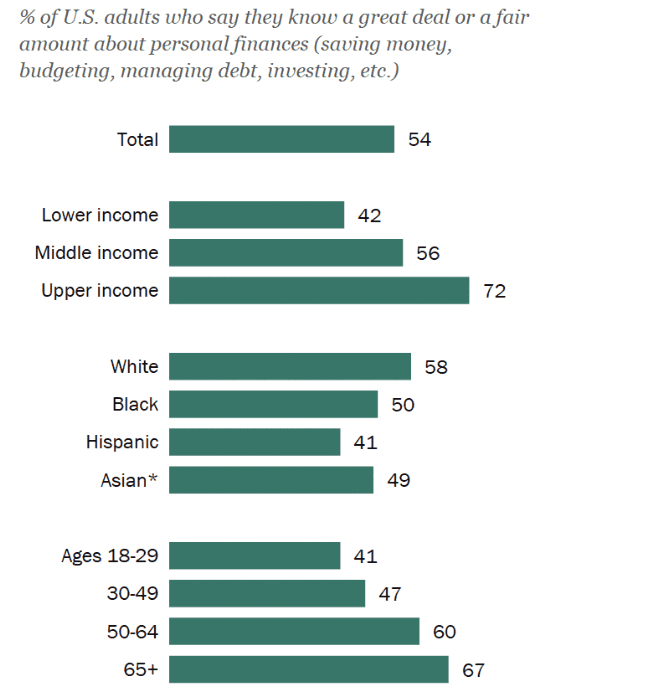
Source: Pew Research Center
Actually, only 54% of Americans say they know a great deal or a fair amount about personal finances. Building practical skills enhances your financial confidence and equips you to make these important "no" decisions with clarity and conviction.
Also read:
Credit Cards 101: Here’s What Happens if You Go Over Your Credit Limit
Balance Transfer or Personal Loan: What is the Right Fit for You?
Save Big, Stress Less: Arro's Tips For Black Friday Budgeting
You're Not Alone In Building Financial Confidence
The stigma around money has lingered for far too long, preventing us from connecting with others and keeping our financial struggles and successes hidden. Psychology Today reports that not talking about money creates stress that impacts mental health, relationships, careers, and financial security.
At Arro, we understand that financial journeys are personal. Everyone makes mistakes, experiences debt, and works toward financial freedom. That’s why we’re here to help you get real with your finances, without judgment.
Take Your First Step Toward Building Credit with Arro
Breaking the silence around money is the first step to transforming your financial life. Building financial confidence isn’t just about knowledge; it’s about community, transparency, and having the right support system.
Credit building should be straightforward, supportive, and enjoyable. With no hard credit checks and no deposit required, you can get started immediately, earning 1% cashback on gas and groceries as you build your credit. Meet Artie, your AI Money Coach, available 24/7 to guide you, celebrate your progress, and help you make smarter financial decisions.
Every on-time payment, every educational lesson, and every small step forward adds up, helping you unlock higher credit limits and build stronger credit health. Thousands are already using Arro to build credit while enjoying the process.
Ready to start your own journey toward financial confidence? Download the Arro app today and discover how easy it can be with the right tools, education, and support system working for you.
FAQs
How can I build financial confidence if I'm just starting to learn about managing money?
Start by educating yourself with simple, bite-sized lessons. Use resources like Arro’s educational tools or financial blogs that break down key concepts in a digestible format. Focus on one small goal at a time, whether it's understanding credit scores or creating a basic budget. As you gain knowledge and make progress, you’ll start to feel more in control of your financial decisions. Remember, building confidence comes with practice and consistency!
What if I struggle to stick to a budget or financial plan?
It’s vital to approach budgeting as a tool for progress, not perfection. If you slip up, don’t get discouraged, adjust your approach, and keep moving forward. Use budgeting apps or tools like Arro to track your spending and set achievable goals. Consider using the “50/30/20 rule” for simple budgeting: allocate 50% to needs, 30% to wants, and 20% to savings. Accountability through a friend, family member, or financial advisor can also keep you on track.
How can I balance saving for the future while still enjoying my present life?
Financial confidence isn’t just about saving; it’s also about enjoying life without guilt. You can set aside a certain percentage of your income for savings while leaving room in your budget for leisure and enjoyment. Try making small sacrifices that don’t compromise your happiness, like cooking at home a few nights a week or setting a limit on impulse purchases.
What role does financial transparency play in building strong relationships?
Being transparent about your financial goals can strengthen relationships by fostering trust and understanding. Discussing your finances openly, whether with a partner, family, or close friends, can create a supportive environment where everyone is on the same page. Transparency doesn’t mean sharing every detail, but it helps set expectations and allows for collaboration on future plans, whether it’s saving for a vacation, buying a home, or managing joint finances.
How can I stay motivated on my financial journey without feeling overwhelmed?
Break your financial journey down into manageable steps. Celebrate small milestones, such as paying off a debt or saving a set amount each month. Use tools like Arro’s AI Money Coach to guide you with personalized tips and encouragement. Surround yourself with a supportive community, whether online or among your friends and family, to share wins and challenges. Remember, progress is personal, and each step forward counts toward your ultimate financial goals.