
Table Of Content
Understanding The Real Cost Of Low Credit
What Is Credit Progress Tracking?
How Artie The Coach Makes Progress Visible
The Psychology Behind Progress Tracking
Turning Daily Habits Into Measurable Financial Wins
Real-World Impact: From Scores to Savings
Building Lasting Financial Confidence
Getting Started With Credit Progress Tracking
FAQ
This disconnect isn't just discouraging; it's costly. According to Experian, people with higher credit scores qualify for lower interest rates because they've proven their creditworthiness over time. But what about those who are actively building their credit? How do you stay motivated when the connection between your actions and your savings feels invisible?
This is where credit progress tracking becomes transformative. It's not just about watching a number go up; it's about understanding exactly how each positive financial habit reduces your costs and builds your confidence for the future. With innovations such as Arro's AI financial coach, Artie, this tracking becomes more personalized, actionable, and motivating than ever before.
Key Takeaways
Credit progress tracking connects daily financial habits to measurable credit score improvements and real cost savings.
Tools like Artie the AI Coach provide personalized, real-time guidance that makes credit building more motivating and actionable.
Improving your credit score by 20-30 points can save thousands on mortgages, auto loans, and credit cards.
Payment history (35%) and credit utilization (30%) are the most important factors to track for credit improvement.
Most people see 40-point increases within 2 months and 100+ point increases within 6 months with consistent habits.
Understanding The Real Cost Of Low Credit
Before diving into credit progress tracking, let's establish why this matters so much. The financial impact of a low credit score extends far beyond approval rates; it affects every dollar you borrow.
The Interest Rate Gap
Research using federal housing and mortgage lending data shows that mortgage rates vary significantly by credit score. On a $300,000 mortgage, the difference between a borrower with a score in the low 600s versus one in the high 700s can result in more than $90,000 in additional interest paid over the life of the loan.
This impact isn’t limited to mortgages. According to the Consumer Financial Protection Bureau, credit scores play a major role in determining interest rates across lending products, including auto loans and credit cards. Even a 100-point difference in credit score can lead to a half-percent or greater increase in interest rates, substantially raising overall borrowing costs.
Beyond Interest Rates
Low credit affects rental applications, insurance premiums, utility deposits, and even employment opportunities. Understanding these stakes makes credit progress tracking essential for long-term financial health.
What Is Credit Progress Tracking?
Credit progress tracking is the systematic monitoring of how your financial behaviors directly influence your credit score and, more importantly, your actual costs over time. Unlike simply checking your credit score monthly, comprehensive credit progress tracking links specific actions to measurable outcomes.
The Three Pillars of Effective Credit Progress Tracking
Effective credit progress tracking includes behavioral monitoring (tracking habits that impact credit), score visualization (seeing credit changes with context), and cost translation (understanding how improvements translate into real savings). According to behavioral finance research, tracking progress is a powerful motivator through the Cue-Routine-Reward Loop.
How Artie The Coach Makes Progress Visible
Arro's AI financial coach, Artie, represents a new evolution in credit progress tracking. Unlike traditional credit monitoring tools that simply report your score, Artie actively helps you understand the "why" and "how" behind your credit journey.
Personalized Progress Insights
Artie provides real-time guidance tailored to your specific financial situation. As mentioned in Arro's approach to credit building, consistent habits lead to measurable improvements within 3-6 months. Artie helps you track these improvements and understand exactly which actions are moving the needle.
From Abstract to Actionable
Instead of generic advice, Artie translates your credit score changes into concrete financial impact. For example:
"Your recent on-time payment increased your score by 8 points, which could save you approximately $15/month on a future auto loan."
"Reducing your credit utilization from 45% to 28% this month puts you on track to qualify for better interest rates within 90 days."
This approach aligns with findings from financial psychology research showing that people are more motivated when they can see tangible results from their efforts.
Real-Time Credit Building Support
Artie offers payment reminders to protect your payment history, credit utilization alerts, educational nudges following behavioral economics principles, and progress celebrations that reinforce positive habits.
The Psychology Behind Progress Tracking
Why does credit progress tracking work so effectively? The answer lies in behavioral psychology and how our brains respond to feedback and progress.
The Power of Visible Progress
According to research on behavioral finance, emotions often drive financial decisions more than logic. When people can't see the impact of their actions, they're more likely to abandon positive behaviors. Credit progress tracking addresses this by making improvement visible and reinforcing good habits.
Neuroplasticity and Financial Habits
Studies show that repeated behaviors create stronger neural pathways in the brain, making those behaviors more automatic over time. The more consistently you practice positive financial behaviors and see them tracked, the more ingrained and automatic those behaviors become.
Overcoming Loss Aversion
Behavioral economics research indicates that people feel losses more intensely than equivalent gains. Credit progress tracking helps reframe the narrative: instead of focusing on what you've lost to high interest rates in the past, you focus on what you're gaining through better habits.
Also, read:
Credit Building 101: Your Complete Guide To Building Credit The Smart Way
Swipe Right On Your Credit Score: Fall in Love With Better Credit This Valentine's Day
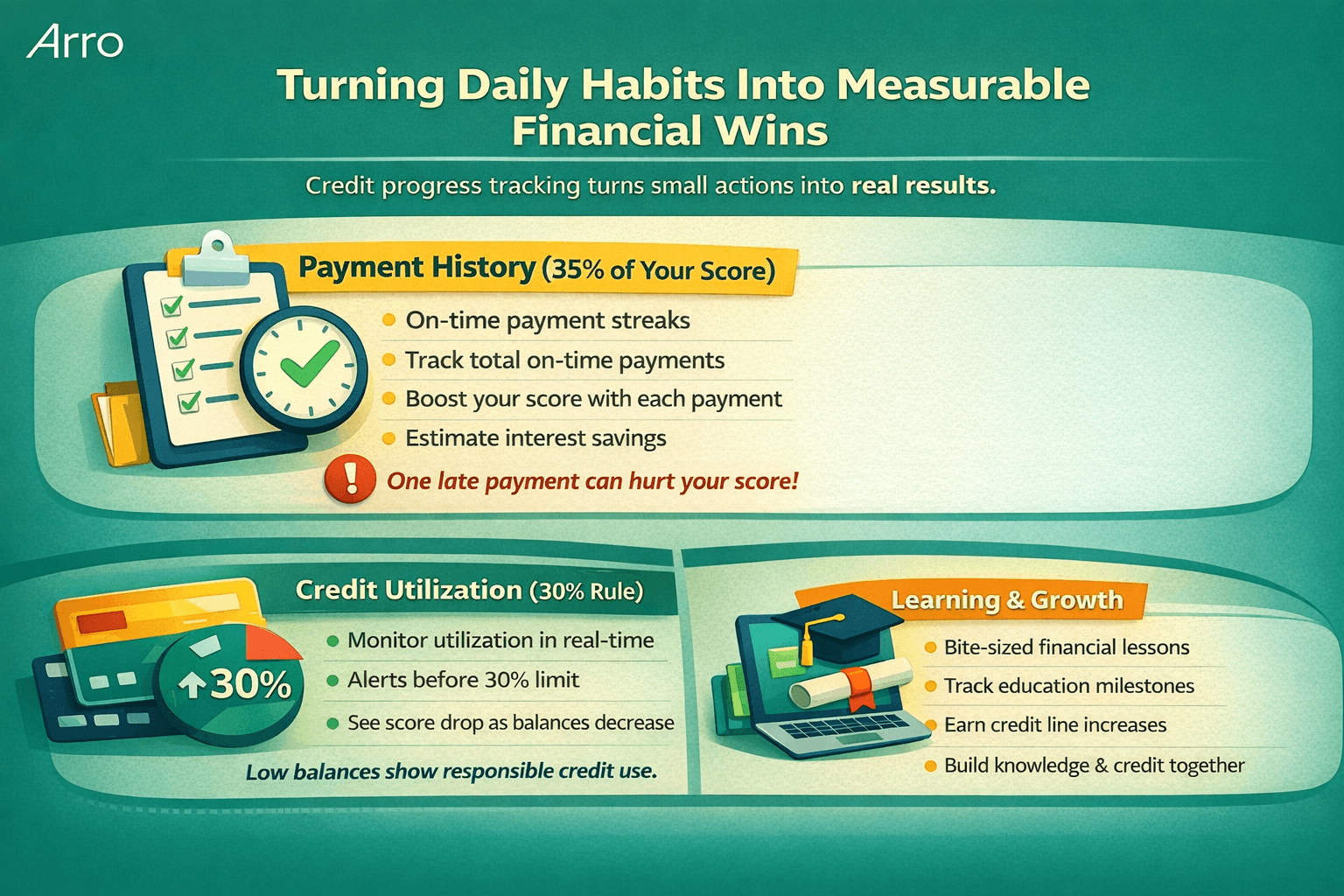
Turning Daily Habits Into Measurable Financial Wins
Credit progress tracking transforms abstract concepts into concrete actions. Here's how specific habits translate into measurable progress:
Payment History: The 35% Solution
Payment history accounts for 35% of your credit score, making it the single most important factor. Credit progress tracking helps you:
Maintain a visual payment streak
See exactly how many on-time payments you've made
Understand how each on-time payment strengthens your credit profile
Calculate the potential interest savings from improved payment history
According to Provident Credit Union, even one late payment can significantly impact your score. Tracking prevents this by keeping your payment history front and center.
Credit Utilization: The 30% Rule
Keeping your credit utilization below 30% is crucial for credit health. With credit progress tracking, you can:
Monitor your utilization ratio in real-time
Set alerts before you approach the 30% threshold
See how reducing utilization impacts your score
Track your progress toward the ideal <10% utilization rate
As highlighted in Arro's credit-building guide, maintaining low utilization demonstrates responsible credit management to lenders.
Learning and Growth
Arro's approach integrates financial education directly into the credit-building process. As noted in their commitment to financial literacy, education is most effective when it's accessible at the moment it's needed. Credit progress tracking helps you:
Complete bite-sized financial lessons
Track which lessons you've completed
Earn credit line increases through education
Build knowledge alongside your credit score
Real-World Impact: From Scores To Savings
The true power of credit progress tracking lies in translating score improvements into real-world financial benefits. Let's look at concrete examples:
Mortgage Savings
According to data from Liberty Bank, improving your credit score by just 20-30 points before applying for a mortgage could significantly lower both your monthly payment and total loan cost.
For a $300,000 mortgage:
Credit score 620-639: Approximately 6.5% APR = $1,896/month
Credit score 760-850: Approximately 5.5% APR = $1,703/month
Monthly savings: $193
30-year savings: Over $69,000
Credit progress tracking helps you visualize exactly how many points away you are from these savings.
Auto Loan Impact
Similar patterns emerge with auto loans. A score improvement from 620 to 680 could reduce your interest rate by 2-3 percentage points, saving thousands over the life of the loan.
Credit Card Interest
For those carrying balances, lower interest rates mean more of each payment goes toward principal rather than interest. This accelerates debt payoff and frees up money for other financial goals.
Building Lasting Financial Confidence
Credit progress tracking doesn't just improve your score, it builds something more valuable: financial confidence.
From Reactive to Proactive
When you can see how your actions impact your financial future, you shift from reactive crisis management to proactive financial planning. This shift is essential for long-term financial health.
Setting SMART Goals
Credit progress tracking enables you to set specific, measurable, achievable, relevant, and time-bound goals.
For example:
"Increase my credit score by 50 points within six months."
"Reduce my credit utilization to below 20% by the end of the quarter."
"Complete 12 financial education lessons this month."
Celebrating Milestones
As emphasized in Arro's approach to growth, recognizing small wins is crucial for maintaining motivation. Credit progress tracking helps you celebrate:
Payment streaks
Score milestones
Educational achievements
Utilization improvements
These celebrations reinforce positive behaviors and build confidence in your financial capabilities.
Getting Started With Credit Progress Tracking
Ready to transform your credit journey? Begin by checking your current credit score through Arro, which reports to all three major credit bureaus. Set clear goals based on your baseline, track daily habits like payment dates and credit utilization, review your progress regularly with Artie's real-time guidance, and celebrate every milestone. Research shows that acknowledging small wins maintains motivation and reinforces positive habits.
Take The First Step Toward Financial Confidence
Credit progress tracking isn't just about improving a number; it's about transforming your relationship with money and building lasting financial confidence. By making the connection between your daily actions and your financial future visible, you gain the motivation and knowledge to create real change.
With tools like Arro's credit-building card and Artie the AI Coach, credit progress tracking becomes personalized, actionable, and genuinely empowering. You don't need perfect credit to start. You don't need a security deposit. You just need to take the first step.
Ready to see how your good habits can transform into real financial progress? Download the Arro app today and start tracking your journey from points to progress. With no hard credit check, instant approval, and personalized guidance from Artie, you can begin building the financial confidence you deserve, starting right now.
FAQ
How long does it take to see improvement in my credit score through credit progress tracking?
According to Arro's credit-building timeline, you can start seeing improvements within 3-6 months of establishing consistent positive habits. Many Arro members see 40-point increases within 2 months, with some achieving 100+ point increases over time. Credit progress tracking helps you visualize these improvements as they happen, making the journey feel more achievable.
How does credit progress tracking differ from just checking my credit score monthly?
Credit progress tracking goes beyond simple score monitoring. While checking your score shows you where you are, credit progress tracking shows you why you're there, how your actions are affecting your score, and what specific changes will have the most impact. It connects your daily financial habits to measurable outcomes and translates score improvements into real-world cost savings.
Can credit progress tracking really help me save money on interest rates?
Absolutely. Research from Experian shows that people with higher credit scores qualify for significantly lower interest rates. By using credit progress tracking to improve your score, you can potentially save thousands of dollars on mortgages, auto loans, and credit cards. The tracking helps you see exactly how many points away you are from better rates.
What habits should I focus on tracking for the best credit improvement?
Focus on tracking these key behaviors:
Payment history (35% of your score): Track on-time payments and maintain a payment streak
Credit utilization (30% of your score): Monitor your balance-to-limit ratio and aim for below 30%
Credit age and mix: Track how long you've maintained accounts
Financial education: Complete lessons that help you understand credit management
Arro's AI coach Artie helps you prioritize which habits will have the most impact on your specific situation.
How does Artie the Coach make credit progress tracking more effective?
Artie personalizes credit progress tracking by providing real-time guidance tailored to your financial situation. Unlike generic credit monitoring, Artie explains what's affecting your score, offers actionable recommendations at the moment you need them, celebrates your wins, and translates score changes into concrete financial benefits. This personalized approach makes credit progress tracking more motivating and effective.
Will using credit progress tracking tools hurt my credit score?
No. Checking your own credit through credit progress tracking tools results in a "soft inquiry," which does not affect your credit score. In fact, regular monitoring is recommended as it helps you catch errors early and track your improvement. Arro uses only soft credit checks, ensuring your application and ongoing tracking never hurt your score.
Is credit progress tracking worth it for someone just starting to build credit?
Especially so! When you're building credit from scratch, every action matters, and credit progress tracking helps you build good habits from the start. It provides the structure and feedback you need to stay on track and avoid common mistakes. For beginners, seeing progress early on builds confidence and reinforces positive behaviors that will serve you throughout your financial life.