
Table Of Content
Why Your First Paycheck Matters For Credit
The No-System Problem
Setting Up Direct Deposit
Creating Your Bill Payment Calendar
First Paycheck Credit Tips
Automating Your Financial Success
Common Mistakes To Avoid
Your 90-Day Roadmap
FAQ
According to the U.S. Bureau of Labor Statistics, nearly 20 million young adults enter the workforce each year, yet most lack a systematic approach to managing their newfound income.
Without a clear system to route bills and savings, new earners find themselves scrambling at month's end. This isn't a willpower problem; it's a systems problem. But with the right framework from day one, you can simultaneously cover expenses, build emergency savings, and establish a credit history that can unlock better interest rates and financial products.
This guide provides actionable first-paycheck credit tips that transform income from short-term spending into long-term wealth-building, showing you how to turn that first deposit into the foundation of financial success through smart direct deposit routing and strategic bill calendar management.
Why Your First Paycheck Matters For Credit
Your first paycheck marks the beginning of financial independence and gives you a real runway to start building credit. Consistent income creates a predictable cash flow, making it easier to pay bills on time and use credit responsibly. Over time, this steady payment behavior becomes the foundation of a strong, healthy credit profile.
Timing Creates Compound Benefits: The earlier you start building credit, the longer your credit history becomes. Payment history and credit age work together to strengthen your profile, with some scoring models rewarding long-standing accounts.
Income Unlocks Credit Products: With verifiable income of at least $1,000 per month, you qualify for credit-building tools designed for newcomers, including products like the Arro Card that don't require security deposits or extensive credit history.
The key is to leverage first paycheck credit tips to create a self-sustaining system where income, bills, and credit-building work in harmony.
The No-System Problem
The primary reason new earners struggle isn't income; it's the absence of a financial operating system. Without clear processes for routing funds and tracking due dates, even generous paychecks can disappear before essential bills are paid.
Common pain points:
Bill Due Date Amnesia: Remembering rent but forgetting utilities, subscriptions, and phone payments until overdraft notices arrive
Paycheck Timing Mismatches: Rent due on the 1st but payday on the 5th creates perpetual shortage cycles
No Savings Autopilot: Intending to save "whatever's left over", which is almost always nothing
Credit Opportunity Loss: Missing chances to establish a positive payment history by not understanding which expenses can build credit
According to the Federal Reserve, 37% of Americans couldn't cover a $400 emergency expense with cash. This vulnerability often begins with the mismanagement of first paychecks.
The solution: A bill calendar paired with direct deposit routing transforms chaos into control, shifting you from reactive scrambling to proactive positioning where every dollar has a destination before it arrives.
Setting Up Direct Deposit
Direct deposit is the cornerstone of effective money management and one of the most important first paycheck credit tips. By routing your paycheck directly into your bank account, you gain immediate access to funds, eliminate check-cashing fees, and create the foundation for automated financial systems.
Your employer uses the Automated Clearing House (ACH) network to transfer wages electronically. On payday, funds appear in your account, often before physical checks clear, with some banks offering direct deposit up to two days early.
Quick Setup Steps:
Obtain bank information: Your routing number (nine-digit code) and account number (found on checks or bank statements)
Complete the employer's form: Provided during onboarding or available from HR
Consider split deposits: Route 80% to checking for bills, 20% to savings automatically, the "pay yourself first" strategy that makes saving effortless
Verify timing: Confirm when direct deposit activates (usually one pay period)
Benefits for credit building:
Predictable timing: Schedule bill payments for the day after payday, ensuring sufficient balance and avoiding late payments
Automated savings: Emergency fund transfers prevent credit card debt during surprises
Fee avoidance: Many banks waive monthly maintenance fees for accounts receiving $1,500+ in regular deposits
Direct deposit takes 15 minutes to set up, but delivers lifelong benefits; it's the first and most crucial of our first paycheck credit tips.
Creating Your Bill Payment Calendar
A bill payment calendar is your visual command center for financial obligations. Unlike traditional monthly budgets, a calendar shows exactly when each bill falls due relative to your paycheck, turning abstract amounts into concrete cash-flow reality.
Research shows people are more likely to stick with shorter-term budgets. Instead of overwhelming monthly totals, you focus on bills due before your next paycheck, matching your planning horizon to your income frequency.
Building Your Calendar:
List all obligations: Rent, utilities, insurance, subscriptions, debt payments, phone, groceries
Mark paydays: Add every payday in a distinctive color; these are your anchor points
Plot due dates: Add each bill's due date using different colors for fixed vs. variable expenses
Identify payment clusters: Look for weeks where multiple large bills coincide; these strain single paychecks
Adjust due dates: Many providers allow you to change payment dates, spread bills across pay periods to prevent feast-or-famine cycles
Calculate per-paycheck budgets: Total bills due before your next paycheck to see available discretionary funds
Tool Options:
Digital: Google Calendar with reminders, apps like Prism or CalendarBudget
Paper: Printable calendars on the refrigerator for daily visual reminders
The best calendar is the one you'll use consistently. Your calendar also reveals which payments could route through a credit card to build payment history, for example, paying a $50 phone bill with a credit-builder card like Arro and immediately paying it off creates positive credit activity at zero cost.
First Paycheck Credit Tips
With direct deposit set up and a bill calendar to organize obligations, let's activate the credit-building component. These first paycheck credit tips transform regular expenses into credit-building opportunities.
Credit Tip #1: Open a Credit Builder Account
Don't wait to "learn the basics" or "save more first." The best time to start building credit is when you receive regular income.
Consider:
Arro Card: No credit check, no security deposit, instant approval with $1,000+ monthly income. Reports to all three major bureaus, TransUnion, Experian, and Equifax.
Arro Credit Builder: A path to the Arro Credit Card with ongoing credit reports and an easy-to-use interface for creating helpful habits and good credit.
The Arro approach requires no upfront capital, making it accessible on day one.
Credit Tip #2: Use Small, Recurring Purchases
Credit Utilization Matters: A large portion of your credit profile is based on how much of your available credit you use. Aim to keep usage below 30%, ideally closer to 10%.
Smart Strategy: Put one or two small bills on your card, like streaming ($15), phone ($50), or gym ($30), then set autopay to pay them off right away. This builds positive payment behavior while keeping balances low.
Credit Tip #3: Pay the Day After Payday
Payment history comprises 35% of your score. A single late payment can drop your score by 60-110 points.
Solution: Schedule credit card payments for the day after the deposit. With direct deposit, you know exactly when funds arrive. Enable autopay for full statement balances to guarantee on-time payments without interest charges.
Credit Tip #4: Track Progress Monthly
Check your credit score regularly to monitor improvement and catch errors early. Many credit apps, including Arro, provide free monthly credit score tracking.
Credit Tip #5: Expand Strategically After 6-12 Months
Once you've established 6-12 months of perfect payments, consider adding a second account. This diversifies your credit mix (10% of score) and increases total available credit (improving utilization). Space applications at least 6 months apart to avoid multiple hard inquiries.
Automating Your Financial Success
Long-term financial success isn't about willpower; it's about automation. Setting up systems that move money automatically removes decision fatigue and human error.
1. Automatic Savings Transfers: Set recurring transfers from checking to savings for the day after each paycheck. Even $25 per paycheck adds up to $650 annually. The Federal Reserve reports that Americans with emergency savings are significantly less likely to miss payments or incur debt during setbacks.
2. Automatic Bill Payments: Enable autopay for fixed expenses (rent, insurance) and minimum payments on variable bills (credit cards, utilities). Maintain a buffer balance equal to 1-2 weeks of expenses to prevent overdrafts.
3. Automatic Credit Card Payoffs: Set cards to automatically pay full statement balances on due dates, guaranteeing on-time payment, zero interest charges, and optimal utilization ratios.
4. Monthly Reviews: Schedule 30-minute "money dates" to review transactions, adjust savings rates, check for unused subscriptions, and monitor credit score progress.
Automation, combined with your bill calendar, creates financial certainty: you know what's coming, when it's coming, and that it will be paid without manual intervention.
Common Mistakes To Avoid
Recognizing common pitfalls helps you sidestep them entirely:
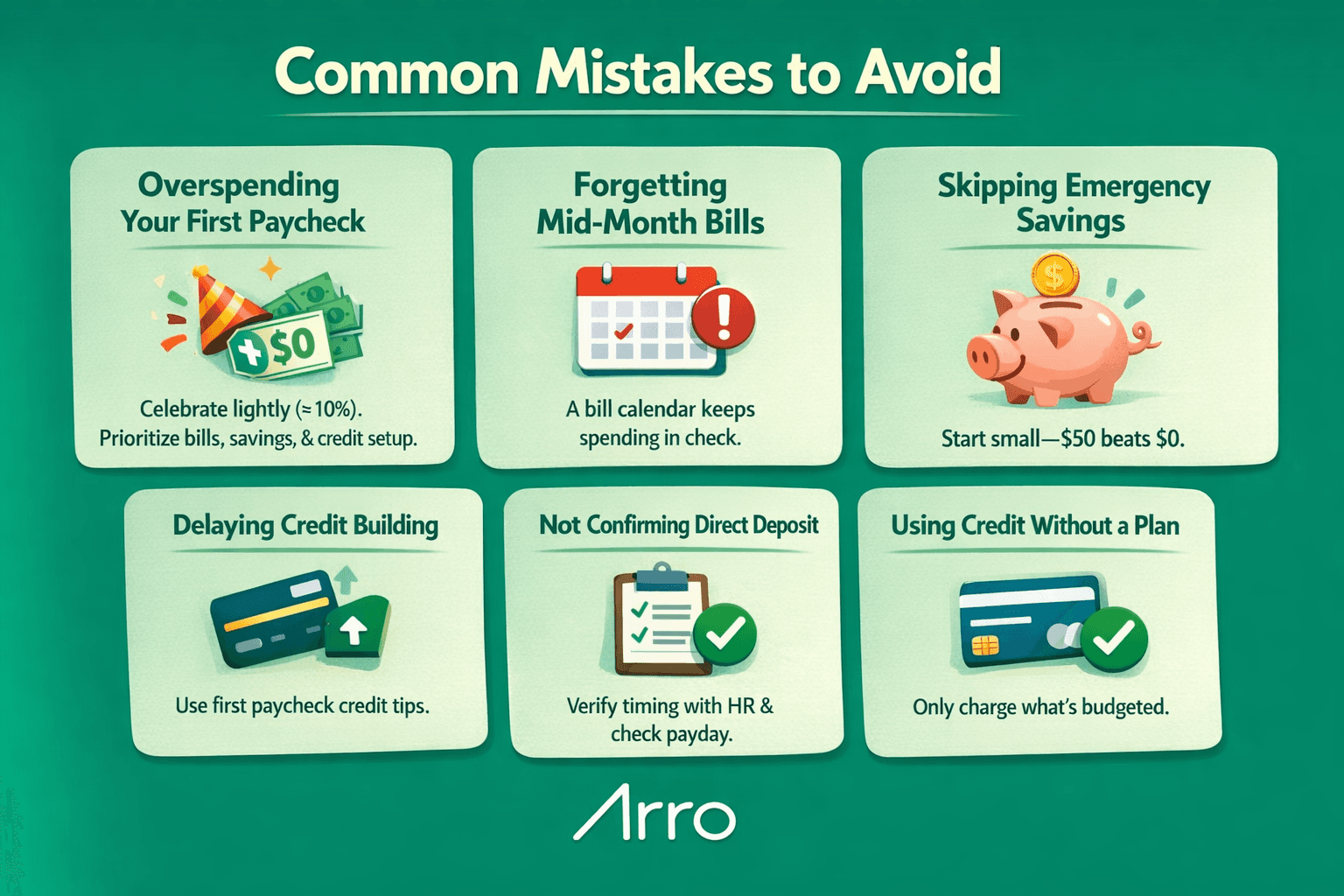
Mistake #1: The Celebration Splurge - Budget a modest celebration (10% of net pay) while dedicating the majority to expenses, savings, and credit-building setup.
Mistake #2: Ignoring the Second Half of the Month - Mid-month paychecks tempt free spending. Your bill calendar prevents this by showing which obligations must be covered before your next paycheck.
Mistake #3: Skipping the Emergency Fund - Start saving with your very first paycheck, even $50 is better than zero.
Mistake #4: Waiting to Build Credit - Apply first paycheck credit tips immediately. Products like Arro include educational resources that teach as you build.
Mistake #5: Neglecting Direct Deposit Verification - Confirm with HR when the first electronic payment processes and monitor your account on that payday.
Mistake #6: Using Credit Without a Payoff Plan - Only use credit for expenses already budgeted and immediately payable from checking.
Your 90-Day Roadmap
Building credit is a marathon, not a sprint. This 90-day roadmap provides a structured path from credit invisibility to measurable progress.
Days 1-7: Foundation Week
Receive first paycheck via direct deposit
Open checking and savings accounts (if needed)
Apply for a credit-builder product (Arro or secured card)
Create a bill calendar, marking all due dates and paydays
Set up automatic savings transfer
Days 8-30: System Establishment
Activate the credit card
Add one small recurring bill to the credit card
Set up autopay for the full balance
Adjust bill due dates if needed
Make the first month's payments on time
Days 31-60: Rhythm Building
Verify credit activity reports to bureaus (check credit monitoring)
Complete financial literacy modules
Increase savings if the budget allows
Maintain a perfect payment record
Request a credit limit increase if offered
Days 61-90: Progress Checkpoint
Pull a free credit report to verify accuracy
Check credit score (expect 600-670 for newcomers)
Evaluate the bill calendar's effectiveness
Consider adding a second small expense to the credit card
Celebrate 90 days of success
Beyond 90 Days: Continue these systems. According to Arro data, members who follow recommendations typically see a 40+ point increase in credit score within 2 months, with some achieving 100+ point improvements over 6-12 months.
Maintain 100% on-time payments, keep utilization below 30%, resist multiple new account applications, and let your oldest account age naturally. Review progress quarterly to stay motivated.
Also, read:
Arro’s Commitment To Financial Literacy - Arro | Grow Credit Your Way
Understanding the Money Stigma and 3 Ways to Build Your Money Confidence
Turn Your First Paycheck Into Lifelong Financial Success
Your first paycheck is more than money; it's a possibility. With the right system from day one, you're not just paying bills; you're building credit history, savings, and financial habits that compound into long-term wealth.
These first paycheck credit tips, establishing direct deposit, creating a bill calendar, automating payments, and strategically using credit-builder products, transform financial management from overwhelming to automatic.
Your Next Step: Don't let another paycheck pass without a system in place. Explore the Arro Card, designed for people starting their credit journey. With no credit check, no deposit required, and financial education built in, Arro makes first-paycheck credit tips actionable from day one.
Your future self will thank you for starting today. Get started with Arro and turn your next paycheck into a credit-building opportunity.
FAQ
How much of my first paycheck should I allocate to credit-building?
Credit building doesn't require direct cash allocation; it requires strategic payment routing. Route existing expenses through your credit-builder card and pay them off immediately. Focus on setting aside 10-20% of your paycheck for emergency savings to prevent debt accumulation.
Can I build credit if my first paycheck is small?
Absolutely. Credit building depends on payment consistency, not size. A $50 monthly phone bill paid on time builds credit as effectively as a $500 rent payment. Products like Arro accommodate lower incomes by starting with smaller credit limits ($50-$300).
How long will it take to see a credit score?
Most credit reporting systems require about six months of account activity before a score is reported. You may see early account activity reflected within one to two billing cycles. The key early on is building consistent, on-time payment habits so your score starts strong when it appears.
Should I set up direct deposit into a checking or savings account?
Checking account. Route your full paycheck there initially, then set up automatic transfers to savings. This prevents temptation while ensuring liquidity for bills.
What if I miss a payment during my first few months?
Act immediately. Call the creditor before the due date to request an extension. Many issuers won't report until payments are 30+ days overdue. This is why autopay is crucial; it prevents human error.
Which bills help build credit?
Typically report: Credit cards, auto loans, student loans, personal loans, mortgages
Usually don't report: Rent, utilities, phone bills, insurance, subscriptions
Strategy: Prioritize on-time payments for credit-reporting accounts while maintaining routine payments on others to avoid collections.
Is it worth getting a credit card solely for credit-building if I prefer debit cards?
Yes, if you use it correctly. Route one or two recurring expenses through the card, set up autopay, then lock the card away. It builds credit without requiring daily use.
Can I build credit while working part-time or gig work?
Yes. Focus on conservative credit limits, a larger emergency buffer (3-6 months of expenses), and income-based spending. Many credit-builder products, including Arro, evaluate alternative sources of income.